What Is The 120% Rule For Solar Installation?


What Is the 120% Rule for Solar? A Homeowner's Complete Guide
The "120% rule" for solar is a widely misunderstood term because it refers to two separate constraints: an electrical safety rule from the National Electrical Code (NEC) limiting power input to your panel's busbar, and a utility policy that can cap your solar system's energy production at 120% of your past usage.
In the world of residential solar, few terms cause more confusion and potential for costly mistakes than the "120% rule." Homeowners often hear it mentioned by a solar installer or see it on a permit application and assume it’s a single, straightforward regulation. The reality is far more complex. This single term describes two fundamentally different limitations that can impact your solar project from opposite directions.
One is a critical fire safety regulation rooted in the National Electrical Code, dictating the physical limits of your home's electrical panel. The other is a policy created by your utility company that dictates the maximum size of the renewable energy system they will allow you to connect to their grid. Mistaking one for the other can lead to an undersized photovoltaic (PV) system that fails to meet your future needs or, worse, an unexpected and expensive main panel upgrade you didn't budget for.
Our core mission at Solar Bear is to empower homeowners with clarity and confidence. With over two decades of experience designing and installing home energy systems, we believe a successful project begins with education. This in-depth guide will demystify both versions of the 120% rule, show you how to determine which is the true bottleneck for your home, and equip you with the right questions to ensure your solar investment is maximized from day one. We answer these questions for our central Florida customers who are on Duke, FPL, TECO, JEA and other providers.
The Source of Confusion: Two Rules, One Name
The primary problem is that both the electrical code and utility policies use the "120%" figure, but they are measuring entirely different things. One is about amps and electrical capacity; the other is about kilowatt-hours and energy production. Understanding this distinction is the first step to a successful solar interconnection.
Rule #1: The NEC 120% Rule for Electrical Safety (The "Busbar Rule")
This is the rule that licensed electricians and detail-oriented solar installers are most concerned with. It’s not about how much energy you use; it’s about the physical capacity of your electrical hardware to handle power from two different sources simultaneously: the utility grid and your solar inverter. This rule is defined in NEC 705.12 and is designed to prevent the main service panel's busbar from dangerously overheating, which could cause a fire. The requirements of NEC Section 705.12, including rules governing busbar capacity, apply to any circuit on the load side of the main service disconnect that can carry currents from both the utility and the PV system. This is purely a matter of electrical code compliance and safety.
Rule #2: The Utility 120% Rule for System Sizing (The "Net Metering Rule")
This rule has nothing to do with the physical hardware in your breaker box. This is an administrative policy set by your local utility company as part of their net metering or interconnection agreement. To manage their grid and financial liabilities, many utilities limit the size of a grid-tied solar system a customer can install. This limit is often set as a percentage of the customer's historical energy consumption, and 120% is a common figure. For example, as a real-world policy, Ohio's net metering rules allow a customer's generating equipment to be sized to offset up to 120% of their own electricity requirements. This rule dictates your system's maximum power production, directly impacting your potential savings and return on investment.
Deep Dive: The Electrical Code's 120% Rule (NEC 705.12)
To truly grasp the electrical 120 rule, you need to understand the components inside your main service panel, also known as a load center or breaker box. The backbone of this panel is the busbar (or bus bar), a metal conductor that distributes power from the main breaker to all the individual circuit breakers for your home's appliances and outlets.
In a standard home, power flows in one direction: from the grid, through the main breaker, onto the busbar, and out through the circuit breakers. When you install a solar energy system, you introduce a second source of power. The solar inverter converts the DC power from your panels into AC power compatible with your home. This power is typically fed into your panel through a new, dedicated "backfed breaker." This is called a load-side connection. Now, the busbar can be energized from both ends: by the utility's power via the main breaker and by your solar panels' power via the backfed breaker. This process is often called solar backfeed.
The danger is overload. The busbar has a specific ampere rating (ampacity), which is the maximum current it can safely handle. If the current from the utility and the current from your solar inverter combined exceed the busbar's rating, it can overheat, posing a serious fire safety risk. The NEC created the 120% rule to provide a safe margin and prevent this overload.
Specifically, the '120% rule' in the NEC dictates that the sum of the ampere ratings of overcurrent devices supplying power to a busbar or conductor must not exceed 120% of the rating of that busbar or conductor. This provides crucial overcurrent protection for the panelboard.
How to Calculate the NEC 120% Rule for Your Panel
So, how does the 120% rule work in practice? The calculation is straightforward and allows you to determine the maximum size of the solar breaker you can safely add to your existing electrical panel. Any licensed electrician performing an electrical load calculation will follow these steps.
- Find Your Busbar Rating: Open your main service panel. The busbar's ampere rating is usually printed on a sticker inside the door or on the panel itself. Common residential ratings are 100A, 125A, 150A, and 200A. A typical 200A service will have a 200 amp busbar.
- Find Your Main Breaker Size: The main breaker is the largest breaker in your panel, usually located at the top or side. The amperage is stamped on the handle. It will typically match the busbar rating (e.g., a 200A main breaker on a 200A busbar).
- Apply the Formula: The formula to find the maximum allowed solar backfed breaker is:
(Busbar Rating × 1.20) – Main Breaker Size = Max Solar Breaker Size
Example Calculation:
Let’s say you have a standard 200A service panel with a 200 amp busbar rating and a 200 amp main breaker.
- (200 Amps × 1.20) = 240 Amps
- 240 Amps – 200 Amps = 40 Amps
In this common scenario, the maximum size solar breaker you can install is 40 amps. This would typically support a solar system of around 7.7 kilowatts (kW), which is a decent size for many homes but may not be enough for those with high energy usage or future plans for an electric vehicle.
What Happens If Your System Fails the 120% Rule?
If your desired solar system requires a larger breaker than the 120% rule allows (e.g., you need a 60 amp breaker but your panel only allows 40 amps), you are not out of options. This is a common challenge, especially in homes with a 100A service or those wanting a very large PV system. A qualified solar installer will present you with several solutions for electrical code compliance, each with its own costs and benefits.
- Option 1: Main Panel Upgrade (MPU). This is the most comprehensive solution. It involves replacing your entire existing load center with a new one that has a higher busbar rating (e.g., upgrading from a 200A panel to a special 225A busbar panel) or one specifically designed for solar integration (a "solar-ready" panel). While it is the most expensive option, an MPU future-proofs your home's electrical system for other high-power needs like an EV charger or a heat pump.
- Option 2: Supply-Side Connection (Line-Side Tap). This is a clever electrical workaround that bypasses the 120% rule entirely. Instead of connecting the solar inverter to a breaker on the busbar (a load-side connection), an electrician connects it directly to the service entrance conductors - the wires between your utility meter and your main breaker. Because the solar power is not being fed onto the busbar, the 120% rule doesn't apply. This requires consent from your Authority Having Jurisdiction (AHJ) and utility, and it has its own set of strict code requirements, but it can be an elegant way to avoid a costly MPU.
- Option 3: Derating the Main Breaker. In some cases, it's possible to replace your existing main breaker with a smaller one. For example, on a panel with a 200A busbar, you could swap the 200A main breaker for a 175A one. Rerunning the calculation, (200A * 1.20) - 175A = 65A - shows you can now install a much larger solar breaker. However, this reduces the total amount of power your home can draw from the grid at one time and requires a new electrical load calculation to ensure your home's circuits won't be overloaded.
- Option 4: Power Control Systems (PCS). Modern technology offers another solution. Companies like Enphase and SolarEdge have developed UL Listed energy management systems that can be installed as part of a home energy system. These systems actively monitor the current on the busbar and can dynamically curtail power from the solar inverter if it ever approaches the panel's safety limits. This allows for a larger physical solar system to be installed while guaranteeing electrical code compliance, often without the need for an MPU.
Why Did My Solar Quote Suddenly Include a Panel Upgrade?
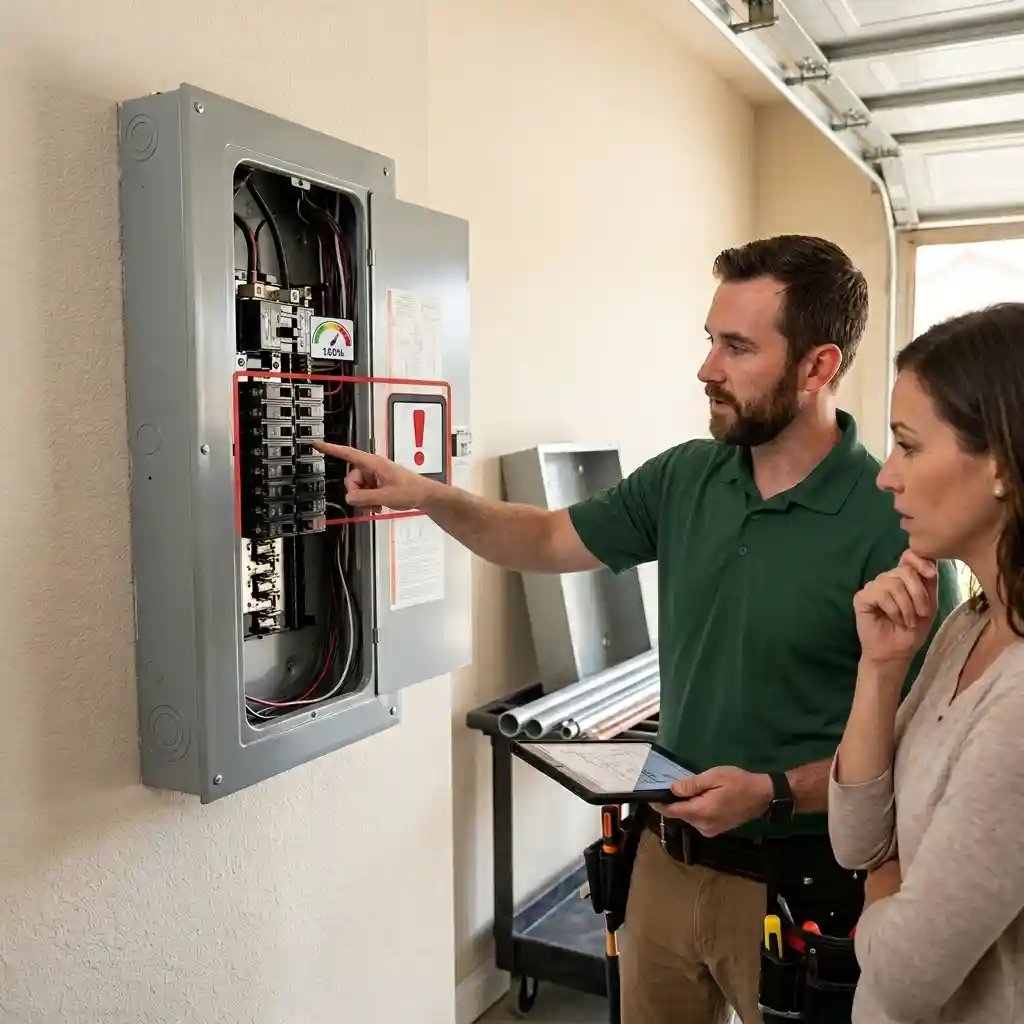
If you received a solar quote and noticed a line item for a "main panel upgrade," "MPU," or "electrical panel replacement" that added $2,000–$5,000 to your project cost, the NEC 120% rule is almost certainly the reason — and your installer isn't padding the bill.
Here's what happened: when your installer's design team sized your system, they ran the 120% busbar calculation on your existing panel. The math came back showing your panel can't safely accommodate the solar breaker required for the system you want. They're now presenting you with the cost to solve that problem before installation can proceed.
This is actually a good sign. It means your installer is doing their job correctly. An installer who skips this calculation and installs an oversized backfed breaker anyway is creating a genuine fire hazard — and one that may not be caught until a home inspection or insurance claim.
What you should ask at this point:
Before automatically accepting a full panel upgrade, push your installer on whether any of these lower-cost alternatives apply to your specific situation:
- Supply-side (line-side) connection - bypasses the busbar entirely by connecting the solar inverter upstream of the main breaker. Not possible in every home, but when it is, it can eliminate the need for an MPU completely.
- Main breaker derate - swapping your existing main breaker for a smaller one recalculates the headroom available for a solar breaker. Works in specific scenarios and costs a fraction of a full MPU.
- Slightly smaller system - if you're close to the limit, downsizing the system by 1–2 panels may bring the required breaker within your panel's existing capacity. Worth modeling if the size difference doesn't significantly impact your payback period.
- Power control system - manufacturers like Enphase and SolarEdge make UL-listed energy management devices that dynamically limit inverter output to stay within safe busbar limits, allowing a larger system without a panel upgrade.
A full MPU is sometimes genuinely the right answer - particularly in older homes with 100A service, or for homeowners planning to add an EV charger or battery backup down the road. In those cases, the upgrade pays for itself in flexibility. But it should be presented to you as one option among several, with clear reasoning for why it's the recommended path — not just a line item dropped into a quote without explanation.
Decoding the Utility's 120% Net Metering Rule
Now, let’s shift gears completely from the physical electrical panel to the administrative world of utility policy. The utility's 120% rule is not about safety; it's about economics and grid management. When you install a grid-tied solar system, you sign an interconnection agreement that governs how you and the utility exchange power.
Utilities offer net metering as a way to credit you for the excess energy your panels produce and send to the utility grid. However, they are not in the business of buying bulk power from countless small residential power generation sources. To control this, they often cap the size of the system you're allowed to build. This cap is frequently based on your historical electricity usage over the previous 12 months. A 120% cap means your proposed solar system cannot be designed to produce more than 120% of the kilowatt-hours (kWh) you consumed in the last year.
This is where a common homeowner frustration arises and leads to the question, "Why is my electric bill so high if I have solar panels?" If your system was sized strictly based on your past usage, and then your lifestyle changes—you buy an electric vehicle, install a pool, or add an electric water heater—your consumption will skyrocket. Your "100% offset" system is now only covering 60% or 70% of your usage, leaving you with a surprisingly high utility bill. The utility's 120% rule can prevent you from building the oversized system you might need to accommodate that future growth.
Your Action Plan: Which "120% Rule" Is Your True Bottleneck?
Determining which 120% rule will be the primary constraint on your project requires a systematic approach. Follow these steps to gain a clear picture before you sign any contract.
- Assess Your Future Energy Needs: This is the most important step. Don't just look at last year's bills. Make a realistic list of any significant electrical additions you plan to make in the next 5-10 years. An EV charger is the most common, adding 3,000-5,000 kWh per year. A new pool pump or electric heat can also be major loads. Your goal is to define your target annual kWh production.
- Investigate Your Utility's Interconnection Policy: Go to your utility company's website and search for terms like "net metering," "interconnection," or "distributed generation." You are looking for their policy documents that state the rules for system sizing. Look for language like "system size shall not exceed X% of the customer's historical annual consumption." This will define your production ceiling.
- Inspect Your Main Service Panel: Safely (or with the help of an electrician) identify your busbar rating and main breaker size. Use the NEC 120% rule formula to calculate the maximum solar breaker your panel can accommodate. This defines your electrical capacity ceiling.
- Ask Your Solar Installer the Right Questions: A reputable solar installer should be able to answer these questions clearly and confidently. If they seem unsure or dismissive, it's a red flag.
- Based on my goal of powering a future EV, which "120% rule"—the NEC electrical code or the utility's production cap—is our first hurdle?
- What is the maximum backfed breaker my current panel can support according to the NEC 120% rule calculation?
- What is my utility's system size limit, and how does your proposed design address it? Can we justify a larger system to the utility based on my future needs?
- Please provide a detailed breakdown of the costs, pros, and cons for all compliance options if my panel is the limiting factor (e.g., MPU vs. supply-side tap).
Key Factors in Your Decision
Navigating the two 120% rules ultimately comes down to balancing three key factors for your specific home and goals. A good partner will make this complex process feel simple, as one of our customers noted, "Very rarely can you say a process could not have gone better — this is one of those times."
Electrical Panel Capacity This is the physical reality of your home. Can your existing main service panel, whether it's made by Square D, Eaton, or another brand, safely accommodate the required solar breaker? An older 100A service is almost always a bottleneck that will require a main panel upgrade. A modern 200A service provides much more flexibility. While an MPU is an added cost, it's also a significant upgrade to your home's infrastructure, ensuring safety and readiness for future technology. Utility Production Limits This is the political and administrative reality of your location. Even with a brand new, oversized electrical panel, your utility holds the final consent. Their production cap can be a hard stop on your ambitions to maximize your roof's potential. Overcoming this often requires clear documentation and a strategic conversation with both your installer and the utility, proving that your future energy needs justify a larger power generation source. Future Energy Needs This is the strategic heart of your project. Sizing a system just to offset 100% of your past usage is often shortsighted. The incremental cost of adding a few more solar panels during the initial installation is far lower than doing a separate project later. This factor forces you to weigh the upfront cost of solutions like an MPU against the long-term risk of an undersized system and persistent utility bills. Incorporating an Energy Storage System (ESS), or solar battery, can also be part of this strategy, allowing you to store excess power for later use, especially with an EV.
Making the Right Choice for Your Needs
There is no single "best" path. The right strategy depends entirely on your home's infrastructure and your personal financial and energy goals. Here is how we advise two common types of homeowners.
For the 'Max-Out' Homeowner
This homeowner wants the largest system their roof can fit. Their goal is to prepare for a future that includes one or two EVs, a pool, and maybe even a battery backup system. They want to maximize long-term savings and energy independence. For them, the primary bottleneck is often the utility's policy limiting system size based on past consumption. The NEC electrical rule is simply a technical problem to be solved; they are usually prepared to invest in a main panel upgrade or a line-side tap to accommodate the large inverter output current. Their key challenge is convincing the utility to approve a system sized for 150% or even 200% of their historical usage. This requires a solar partner who is an expert in navigating utility interconnection agreements.
For the 'Budget-Conscious' Homeowner
This homeowner lives in a home that may be a few decades old and has perfectly functional, but limited, electrical infrastructure. Their goal is to offset as much of their current bill as possible without breaking the bank on expensive electrical work. For them, the primary bottleneck is often the NEC's 120% electrical code rule for busbar safety. A potential $4,000 MPU could make the entire project financially unappealing. Their best path forward is to work with a highly skilled solar installer and licensed electrician who can explore all the lower-cost compliance options. Can a supply-side connection be performed? Is derating the main breaker a safe option? Or can a slightly smaller system be designed to fit perfectly within the panel's existing capacity? For this homeowner, efficiency and expertise in the installation are paramount. They need a team that gets it right the first time, like the one a recent customer praised: “Installed in ONE DAY, and passed inspection the NEXT DAY.”
Ultimately, navigating the dual "120% rules" requires a partner who values transparency and technical excellence above all else. At Solar Bear, our in-house team of NABCEP-certified technicians and master electricians has spent over 20 years mastering the nuances of the National Electrical Code and the specific interconnection requirements of utilities nationwide. We believe in building robust, hurricane-rated systems on a foundation of unshakeable electrical safety and compliance. For a definitive analysis of your home’s potential, a clear explanation of which 120% rule applies to you, and a no-nonsense quote, contact the experts at Solar Bear in Central Florida today. We ensure your solar journey is safe, successful, and built for a lifetime of savings.